
AI is pushing global infrastructure to its limits, and some of the world’s most influential tech leaders are looking far beyond Earth for answers. Space is quickly becoming the next frontier for computing power as companies race to place AI data centers in orbit. What once sounded like science fiction now sits firmly on corporate roadmaps, backed by real investments, firm timelines, and bold projections.
Recent reporting confirms that Blue Origin, SpaceX, and Google are actively working on space-based computing systems. These projects aim to solve a growing problem on Earth: the massive energy demand required to run modern AI models. With data centers consuming more power every year, orbit offers an alternative that changes the math entirely.
Why Space Is Drawing Serious Attention
Energy demand is the driving force behind this shift. Global electricity consumption is expected to double by 2050, and AI data centers are a major contributor. In the United States alone, data centers have become the fastest-growing source of electricity demand.
The numbers explain the urgency:
1. Data centers used 1.8% of total U.S. electricity in 2014
2. By 2030, that figure could rise to 9%, according to Bain & Co.
Space offers advantages that Earth cannot match. Solar panels in orbit generate up to eight times more energy than those on the ground. Natural cooling in space also reduces the need for power-hungry cooling systems. Together, these benefits make orbital data centers an attractive option as AI workloads grow heavier.
Blue Origin and SpaceX Move First

Instagram | litnewsnet | Blue Origin is developing orbital AI centers to support large-scale infrastructure.
According to The Wall Street Journal, Blue Origin has spent more than a year developing orbital AI data center technology. The effort reflects Jeff Bezos’s long-standing view that space can support large-scale infrastructure that improves life on Earth.
SpaceX has taken a more direct approach. The company has pitched AI-capable Starlink satellites in a planned share sale that could value SpaceX at around $800 billion. These satellites would not just provide connectivity but also process data directly in orbit.
Both companies see space-based compute power as a long-term solution to Earth’s energy constraints rather than a short-term experiment.
Google Pushes Its Own Space Computing Plan
Google entered the race with Project Suncatcher, a research initiative focused on building data centers in space. The company plans to test two prototype satellites by 2027.
The system would rely on a network of solar-powered satellites using Google’s TPU chips. These tensor processing units already power Google’s latest AI model, Gemini 3. Data would move between satellites using laser-based communication, reducing latency and dependence on ground-based infrastructure.
Google CEO Sundar Pichai summarized the logic clearly:
“When you truly step back and envision the amount of compute we’re going to need, it starts making sense and it’s a matter of time.”
Elon Musk Raises the Stakes
Elon Musk has confirmed that SpaceX plans to scale Starlink V3 satellites into full space-based data centers. The performance jump is significant. While Starlink V2 mini satellites top out at around 100 Gbps, Starlink V3 satellites are designed to deliver up to 1 terabit per second.
SpaceX plans to launch 60 of these high-capacity satellites per Starship flight starting in 2026. Musk stated on X that Starship could eventually deliver between 300 and 500 gigawatts of solar-powered AI satellites into orbit each year.
For comparison, global data center capacity on Earth currently stands at about 59 gigawatts. Musk’s proposal would add several times that amount annually.
Tight Timelines and New Entrants
Several other companies are moving quickly to secure early positions.
Starcloud recently sent a satellite equipped with Nvidia’s H100 GPU into orbit. The company aims to operate a GPU-based satellite system by 2026.
Axiom Space has announced plans to deploy orbital data center nodes by the end of 2025. Lonestar Data Holdings has already tested a compact data center on the Moon, completing a trial in March.
Each step brings orbital computing closer to operational reality, while also setting competitive benchmarks across the industry.
Technical Barriers That Cannot Be Ignored
Building and maintaining data centers in orbit presents serious engineering challenges. Radiation poses a constant threat to sensitive components like GPUs, requiring heavy shielding and redundant systems. Solar storms and cosmic rays add another layer of risk.
Orbital debris also raises concerns. Collisions with defunct satellites or rocket fragments could damage infrastructure or trigger cascading failures known as the Kessler syndrome. Heat management is another issue, as removing heat in a vacuum demands advanced thermal designs.
Maintenance remains complex. Repairs and upgrades that are routine on Earth become costly and difficult in orbit, requiring new approaches to hardware longevity and modular design.
The Shifting Economics of Space Computing
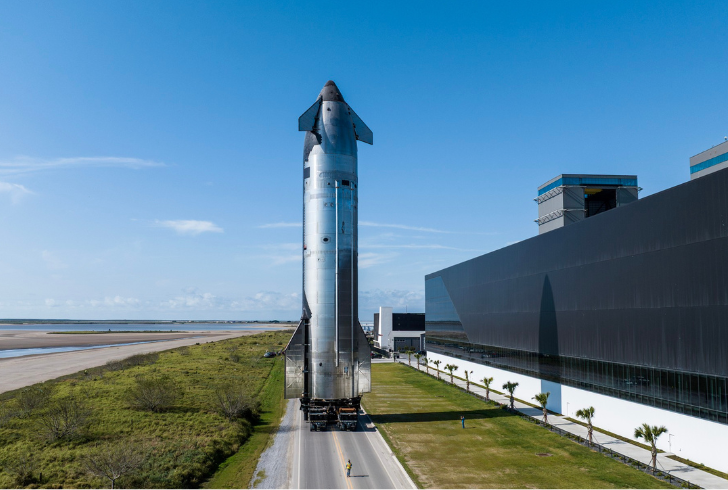
Instagram | spacex | SpaceX’s Starship could slash costs enough to make space data centers practical.
Cost has always been the biggest obstacle, but that barrier is shrinking. Google’s research suggests that falling launch costs could make orbital data centers competitive with Earth-based facilities by the mid-2030s.
Advances such as SpaceX’s Starship could lower launch costs to under $200 per kilogram. At that price point, large-scale orbital infrastructure becomes financially realistic rather than theoretical.
This shift could reshape cloud computing. Orbital providers may one day compete with AWS, Azure, and Google Cloud. Companies using multi-cloud strategies could soon evaluate space-based options alongside traditional data centers.
Control, Power, and Global Implications
The race now extends beyond technology. Control of space-based compute infrastructure carries economic and geopolitical weight. Data centers in orbit over international waters could raise new questions about jurisdiction, data sovereignty, and regulatory oversight.
Jeff Bezos has said that space will be one of the places that keeps making Earth better. Research by Phil Metzger supports that view, suggesting the business case for space-based data centers could become viable within a decade.
Bezos’s belief that gigawatt-scale computing could move off-planet within 20 years no longer sounds distant. The coming decade will determine whether orbital AI data centers become standard infrastructure or remain an ambitious gamble by the world’s wealthiest tech leaders.
The push to build AI data centers in space reflects a deeper shift in how computing power is sourced and distributed. Energy limits on Earth, combined with rapid AI growth, are forcing new thinking at a planetary scale. With Blue Origin, SpaceX, Google, and emerging players investing heavily, space-based computing is moving from theory to execution. The outcome of this race may redefine where and how the world’s most important data is processed.